
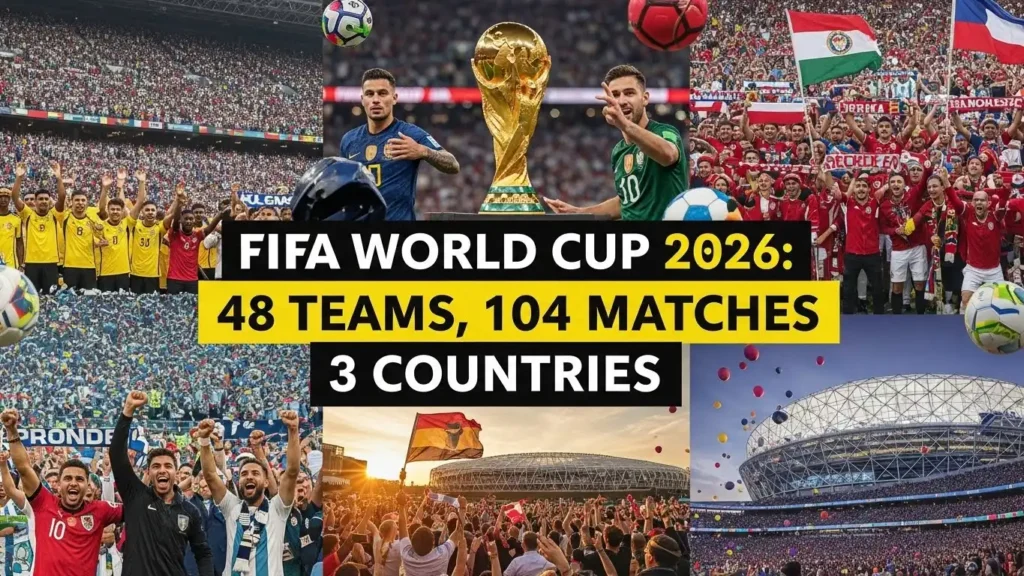
FIFA World Cup 2026: Host Cities, Format Changes & Get Tickets
The FIFA World Cup is coming back to North America, and this time it’s going to be unlike anything we’ve ever seen.
For the first time in the tournament’s nearly 100-year history, three countries will co-host the event. The United States, Canada, and Mexico are joining forces to welcome 48 nations up from the traditional 32 across 16 cities and some of the most iconic stadiums in the world.
If you’re a soccer fan, casual viewer, or just someone who loves major sporting events, the 2026 World Cup is shaping up to be the most accessible, diverse, and exciting edition yet. Here’s everything you need to know.
Why the 2026 World Cup Is Different From Every Other Edition
The last World Cup held in North America was USA 1994, which still holds the record for highest total attendance nearly 3.6 million fans across 52 matches. That tournament helped spark a soccer revolution in the United States, leading to the creation of Major League Soccer (MLS) and a massive growth in youth participation.
Now, 32 years later, the tournament returns to a completely different landscape. Soccer is no longer a fringe sport in North America. MLS has 30 teams, the region has world-class training facilities, and millions of fans follow European leagues religiously.
But the biggest change? The tournament itself has expanded.
The Expansion to 48 Teams
FIFA officially expanded the World Cup format from 32 to 48 teams starting in 2026. That means 16 more nations will compete, giving countries from smaller confederations a better chance to qualify.
Here’s how the slots break down by region:
- UEFA (Europe): 16 spots
- CAF (Africa): 9 spots
- AFC (Asia): 8 spots
- CONMEBOL (South America): 6 spots
- CONCACAF (North/Central America & Caribbean): 6 spots (3 are the host nations)
- OFC (Oceania): 1 spot
- Intercontinental Playoffs: 2 spots
This expansion has been controversial among purists who worry about diluting the quality of play. But FIFA’s argument is simple: more nations mean more global engagement, more fans, and more opportunities for developing soccer countries.
The format will feature 12 groups of four teams each. The top two from each group advance, plus the eight best third-place teams. That brings us to a 32-team knockout round, similar to what we’ve seen in previous tournaments.
In total, there will be 104 matches instead of the usual 64, a 62% increase in game action.
The Three Host Nations and 16 Host Cities
One of the most exciting aspects of the 2026 World Cup is its geographic scale.
The tournament will span three countries, two time zones, and thousands of miles. While this presents logistical challenges more on that later it also means fans from across North America can experience the World Cup without crossing an ocean.
Host Cities in the United States (11)
The U.S. will host the majority of matches, including the final. Here are the American cities involved:
- MetLife Stadium (East Rutherford, New Jersey)
- Mercedes-Benz Stadium (Atlanta, Georgia)
- Arrowhead Stadium (Kansas City, Missouri)
- AT&T Stadium (Arlington, Texas)
- Gillette Stadium (Foxborough, Massachusetts)
- Hard Rock Stadium (Miami Gardens, Florida)
- Levi’s Stadium (Santa Clara, California)
- Lincoln Financial Field (Philadelphia, Pennsylvania)
- Lumen Field (Seattle, Washington)
- NRG Stadium (Houston, Texas)
- SoFi Stadium (Inglewood, California)
The final is widely expected to be held at MetLife Stadium in New York/New Jersey or AT&T Stadium in Texas, though FIFA has not officially confirmed this yet.
Host Cities in Mexico (3)
Mexico has hosted the World Cup twice before (1970 and 1986), making it the first country to host or co-host three editions.
- Estadio Azteca (Mexico City)
- Estadio Akron (Guadalajara)
- Estadio BBVA (Monterrey)
Estadio Azteca is legendary. It’s where Pelé lifted the Jules Rimet Trophy in 1970 and where Diego Maradona scored the “Hand of God” goal in 1986. Playing there is a pilgrimage for any soccer fan.
Host Cities in Canada (2)
Canada is hosting its first-ever World Cup matches, a huge moment for a country where soccer has exploded in popularity over the past decade.
- BMO Field (Toronto, Ontario)
- BC Place (Vancouver, British Columbia)
Canada’s men’s team qualified for the 2022 World Cup after a 36-year absence, signaling the country’s rise as a serious soccer nation.
Read Also: https://clubworldcupnow.com/fifa-houston-2026/
When Does It Start and How Long Does It Last?
FIFA has not yet announced the exact dates for the 2026 World Cup, but based on past tournaments and scheduling logistics, here’s what we can expect:
- Start Date: Mid-June 2026
- Final: Mid-July 2026
- Duration: Approximately 39 days
The tournament will likely kick off in Mexico City at Estadio Azteca, following tradition and honoring Mexico’s deep soccer history.
Because of the expanded format, teams will have slightly shorter rest periods between matches, and fans will have more games to follow. Group stage matches will likely be played across all 16 host cities simultaneously, creating a festival atmosphere across the continent.
What Teams Are Expected to Compete?
Qualifying matches are still ongoing as of late 2024 and early 2025, but here’s what we know:
Automatic Qualifiers
- United States
- Mexico
- Canada
All three host nations automatically qualify, which is standard for World Cup hosts.
Favorites to Qualify
Based on FIFA rankings, recent form, and confederation strength, these nations are near-locks:
Europe: France, England, Germany, Spain, Portugal, Belgium, Netherlands, Italy, Croatia, Denmark
South America: Argentina (reigning champions), Brazil, Uruguay, Colombia, Ecuador, Chile
Africa: Senegal, Morocco, Nigeria, Egypt, Cameroon, Tunisia, Algeria
Asia: Japan, South Korea, Iran, Australia, Saudi Arabia, Qatar
CONCACAF: Jamaica, Costa Rica, Panama (competing for remaining spots)
But surprises always happen. Smaller nations like Iceland, Wales, and North Macedonia have shocked the world in recent years, and the expanded format gives them more chances.
Key Storylines to Watch
Can Argentina Repeat?
Argentina won the 2022 World Cup in Qatar, with Lionel Messi finally lifting the trophy in what was likely his last World Cup. By 2026, Messi will be 39 years old. Will he even play? If not, can Argentina defend their title without him?
The Rise of African and Asian Teams
With more slots available, African and Asian nations have a better chance to break into the knockout rounds and beyond. Morocco made history in 2022 by becoming the first African team to reach the semifinals. Could an African nation go even further in 2026?
Will the U.S. Finally Break Through?
The U.S. men’s national team has never won a World Cup, and its best finish was third place in 1930. But with home-field advantage, a young and talented squad (Christian Pulisic, Weston McKennie, Gio Reyna, Yunus Musah), and massive fan support, 2026 could be their year to shock the world.
Canada’s Coming-Out Party
Canada’s 2022 World Cup run was brief but promising. Players like Alphonso Davies (Bayern Munich) and Jonathan David (Lille) are world-class talents. With home matches in Toronto and Vancouver, Canada could surprise everyone.
The Logistics: Travel, Tickets, and Fan Experience
Let’s talk about the practical side of attending the 2026 World Cup.
Travel Distances
One major criticism of the tri-nation format is the distance between cities. A team could play in Vancouver, then fly to Miami, then head to Mexico City, covering over 5,000 miles in a matter of weeks.
For fans, this means planning trips carefully. If your team advances deep into the tournament, you might be flying across the continent multiple times.
However, FIFA has committed to regionalizing the group stage as much as possible, meaning teams will play their first three matches within a limited geographic area. This reduces travel strain and keeps fan bases more localized.
Ticket Sales
FIFA typically releases tickets in phases:
- Random Selection Draw (first phase)
- First-Come, First-Served (second phase)
- Last-Minute Sales (final phase)
Tickets for the 2026 World Cup will likely go on sale in late 2025. Expect prices to range from $100 for group stage matches to several thousand dollars for the final.
Given the size of the stadiums involved, many NFL venues with 70,000+ capacity, there should be more tickets available than any previous World Cup.
Fan Zones and Viewing Parties
FIFA and the host cities will set up official fan zones in downtown areas where fans can watch matches on giant screens, enjoy food and music, and soak in the atmosphere even if they don’t have tickets to the stadium.
These fan zones were a massive success in 2022 and are expected to be even bigger in 2026, especially in cities with large immigrant populations and passionate soccer cultures.
What This Means for Soccer in North America
The long-term impact of the 2026 World Cup could be massive.
MLS is expanding rapidly, with new teams launching in cities like San Diego and Las Vegas. The quality of play is improving, and more international stars are choosing to play in North America during their prime years.
Youth participation is at an all-time high. According to U.S. Soccer, over 3 million kids play organized soccer in the United States, and that number is growing.
Canada and Mexico are also investing heavily in soccer infrastructure. Mexico’s Liga MX is one of the most-watched leagues in North America, and Canada’s domestic league (Canadian Premier League) launched in 2019 and is steadily growing.
The World Cup will serve as a showcase not just for the tournament itself, but for the entire region’s soccer potential.
Frequently Asked Questions About FIFA World Cup 2026
How many teams will play in the 2026 World Cup?
48 teams will compete, up from 32 in previous tournaments. This is the first World Cup with this expanded format.
Where will the final be played?
FIFA has not officially confirmed the final venue, but MetLife Stadium in New York/New Jersey and AT&T Stadium in Texas are the leading candidates.
Can I buy tickets now?
Not yet. Tickets are expected to go on sale in late 2025 through FIFA’s official ticketing platform.
Will Lionel Messi play in 2026?
Messi will be 39 years old by the time the tournament starts. He has not confirmed whether he’ll participate, but most analysts believe 2022 was his final World Cup.
How does the new format work?
There will be 12 groups of four teams. The top two from each group advance, plus the eight best third-place teams. That creates a 32-team knockout round.
Which countries have the best chance to win?
Argentina (defending champions), France, Brazil, England, and Spain are considered the top favorites based on current form and squad depth.
Will there be VAR (Video Assistant Referee)?FIFA World Cup 2026: Complete Guide to Hosts, Teams, Schedule & Tickets
Yes. VAR has been used in every World Cup since 2018 and will be used in 2026 as well.
How can I watch matches if I’m not in North America?
Broadcasting rights vary by country, but major networks like BBC (UK), ARD/ZDF (Germany), and beIN Sports (Middle East) typically hold rights. Streaming options will also be widely available.
What Happens After 2026?
The World Cup will return to a single-host format in 2030, with Spain, Portugal, and Morocco co-hosting, along with special centenary matches in South America.
By then, the 48-team format will be the new normal, and FIFA will have learned valuable lessons from the 2026 edition about how to manage such a massive event across multiple nations.
For now, all eyes are on North America. The countdown is on, and the world is ready to watch.
Whether you’re a die-hard fan who’s been following soccer your whole life or someone who only tunes in every four years, the 2026 World Cup promises to be unforgettable. With more teams, more cities, more matches, and more storylines than ever before, it’s shaping up to be the biggest celebration of soccer the world has ever seen.

